@PersistenceContext 애너테이션
- spring-boot
- jpa
이 글의 목차
0. 들어가면서
EntityManagerFactory 클래스 포스트에선 스레드 안전(thread safe)하지 않은 엔티티 매니저(EntityManager)를 안전하게 사용하는 방법들 중 한 가지인 EntityManagerFactory 클래스에 대해 정리하였다. 이번엔 @PersistenceContext 애너테이션을 통해 엔티티 매니저의 스레드 안전성을 도모하는 방법에 대해 정리해보았다.
1. @PersistenceContext 애너테이션
@Autowired 애너테이션을 통해 빈(bean)을 주입 받듯이 @PersistenceContext 애너테이션을 사용하면 EntityManager 빈을 주입 받을 수 있다. EntityManager의 실제 구현 클래스의 객체가 아닌 프록시(proxy) 객체를 주입 받는다.
EntityManagerProxy 인터페이스
package org.springframework.orm.jpa;

import javax.persistence.EntityManager;

public interface EntityManagerProxy extends EntityManager {


    EntityManager getTargetEntityManager() throws IllegalStateException;

}
@PersistenceContext 애너테이션을 통한 빈 주입
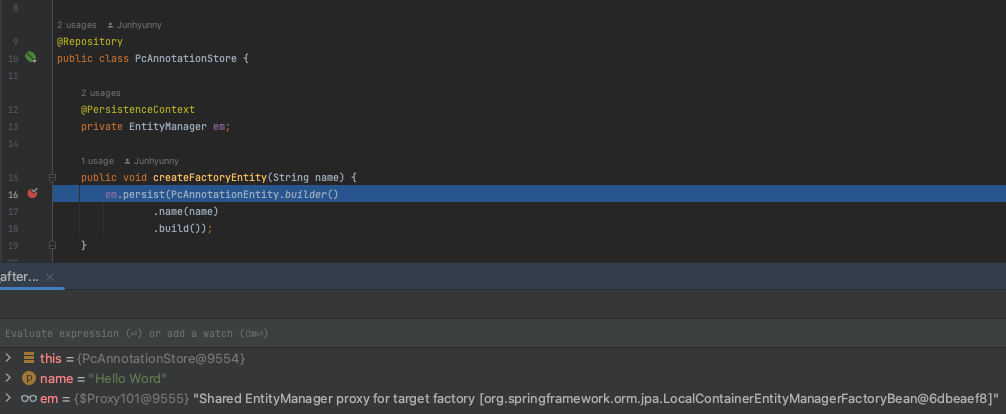
2. SharedEntityManagerInvocationHandler 클래스
주입 받은 엔티티 매니저를 호출하면 프록시 내부에 invocationHandler 객체로 등록된 SharedEntityManagerInvocationHandler 인스턴스를 사용한다. SharedEntityManagerInvocationHandler 인스턴스의 invoke 메서드를 살펴보면 다음과 같은 내용을 확인할 수 있다.
EntityManagerFactoryUtils.doGetTransactionalEntityManager호출 라인- 해당 스레드에 트랜잭션이 시작된 엔티티 매니저가 있다면 이를 반환한다.
- 해당 스레드에 엔티티 매니저가 없다면 새로운 엔티티 매니저를 생성 후 반환한다.
Object result = method.invoke(target, args)호출 라인- 획득한 엔티티 매니저(target)로 프록시 외부에서 호출한 메서드를 실행한다.
    @Override
    @Nullable
    public Object invoke(Object proxy, Method method, Object[] args) throws Throwable {

        // ...

        // Determine current EntityManager: either the transactional one managed by the factory or a temporary one for the given invocation.
        EntityManager target = EntityManagerFactoryUtils.doGetTransactionalEntityManager(
                this.targetFactory, this.properties, this.synchronizedWithTransaction);

        switch (method.getName()) {
            case "getTargetEntityManager":
                if (target == null) {
                    throw new IllegalStateException("No transactional EntityManager available");
                }
                return target;
            case "unwrap":
                Class<?> targetClass = (Class<?>) args[0];
                if (targetClass == null) {
                    return (target != null ? target : proxy);
                }
                if (target == null) {
                    throw new IllegalStateException("No transactional EntityManager available");
                }
                break;
        }

        // ...

        // Invoke method on current EntityManager.
        try {
            Object result = method.invoke(target, args);
            if (result instanceof Query) {
                Query query = (Query) result;
                if (isNewEm) {
                    Class<?>[] ifcs = cachedQueryInterfaces.computeIfAbsent(query.getClass(), key ->
                            ClassUtils.getAllInterfacesForClass(key, this.proxyClassLoader));
                    result = Proxy.newProxyInstance(this.proxyClassLoader, ifcs,
                            new DeferredQueryInvocationHandler(query, target));
                    isNewEm = false;
                }
                else {
                    EntityManagerFactoryUtils.applyTransactionTimeout(query, this.targetFactory);
                }
            }
            return result;
        } catch (InvocationTargetException ex) {
            throw ex.getTargetException();
        } finally {
            if (isNewEm) {
                EntityManagerFactoryUtils.closeEntityManager(target);
            }
        }
    }
3. Example
EntityManagerFactory 클래스를 직접 사용하면 @Transactional 애너테이션을 통한 트랜잭션 처리가 불가능하다. 반면에 @PersistenceContext 애너테이션을 통해 주입 받은 엔티티 매니저를 사용하면 @Transactional 애너테이션을 통한 트랜잭션 처리가 가능하다. 간단한 예시 코드를 통해 확인해보겠다.
3.1. PcAnnotationService 클래스
- 데이터 생성 후 조회하는 간단한 비즈니스 로직을 트랜잭션 처리한다.
- 롤백을 유도하기 위해 플래그(flag) 값으로 의도적인 예외를 던진다.
package action.in.blog.annotation;

import org.springframework.stereotype.Service;
import org.springframework.transaction.annotation.Transactional;

@Service
public class PcAnnotationService {

    private final PcAnnotationStore pcAnnotationStore;

    public PcAnnotationService(PcAnnotationStore pcAnnotationStore) {
        this.pcAnnotationStore = pcAnnotationStore;
    }

    @Transactional
    public PcAnnotationEntity findEntityAfterInsert(String name, boolean intentionallyException) {
        pcAnnotationStore.createFactoryEntity(name);
        if (intentionallyException) {
            throw new RuntimeException("throw intentionallyException");
        }
        return pcAnnotationStore.findByName(name);
    }
}
3.2. PcAnnotationStore 클래스
- 엔티티 매니저를
@PersistenceContext애너테이션을 통해 주입 받는다. - 데이터 추가, 조회 기능을 제공한다.
package action.in.blog.annotation;

import org.springframework.stereotype.Repository;

import javax.persistence.EntityManager;
import javax.persistence.PersistenceContext;
import javax.persistence.TypedQuery;

@Repository
public class PcAnnotationStore {

    @PersistenceContext
    private EntityManager em;

    public void createFactoryEntity(String name) {
        em.persist(PcAnnotationEntity.builder()
                .name(name)
                .build());
    }

    public PcAnnotationEntity findByName(String name) {
        TypedQuery<PcAnnotationEntity> query = em.createQuery("select pc from PcAnnotationEntity pc where pc.name = :name", PcAnnotationEntity.class);
        query.setParameter("name", name);
        return query.getSingleResult();
    }
}
4. Tests
- 예외가 발생하지 않는 경우
- 데이터가 정상적으로 추가된다.
- 추가된 데이터를 DB에서 발급받은 ID로 조회할 수 있다.
- 예외가 발생하는 경우
- 데이터가 정상적으로 추가되지 않는다.
- 데이터 검색 시 NoResultException 예외가 발생한다.
package action.in.blog.annotation;

import org.junit.jupiter.api.DisplayName;
import org.junit.jupiter.api.Test;
import org.springframework.beans.factory.annotation.Autowired;
import org.springframework.boot.test.context.SpringBootTest;

import javax.persistence.*;

import static org.hamcrest.MatcherAssert.assertThat;
import static org.hamcrest.Matchers.equalTo;
import static org.junit.jupiter.api.Assertions.assertThrows;

@SpringBootTest
public class PcAnnotationServiceIT {

    @PersistenceUnit
    EntityManagerFactory factory;

    @Autowired
    PcAnnotationService sut;

    @Test
    @DisplayName("정상 처리되면 데이터베이스에 데이터가 저장된다.")
    void find_entity_with_exception_after_insert() {

        EntityManager entityManager = factory.createEntityManager();


        PcAnnotationEntity pcAnnotationEntity = sut.findEntityAfterInsert("Hello Word", false);


        PcAnnotationEntity result = entityManager.find(PcAnnotationEntity.class, pcAnnotationEntity.getId());
        assertThat(result.getName(), equalTo(pcAnnotationEntity.getName()));
    }

    @Test
    @DisplayName("비즈니스 로직 중간에 예외가 발생하는 경우 데이터가 롤백된다.")
    void rollback_data_with_exception_after_insert() {
        EntityManager entityManager = factory.createEntityManager();


        RuntimeException exception = assertThrows(RuntimeException.class, () -> {
            sut.findEntityAfterInsert("Hello World", true);
        });
        assertThat(exception.getMessage(), equalTo("throw intentionallyException"));
        assertThrows(NoResultException.class, () -> {
            TypedQuery<PcAnnotationEntity> query = entityManager.createQuery("select pc from PcAnnotationEntity pc where pc.name = :name", PcAnnotationEntity.class);
            query.setParameter("name", "Hello World");
            query.getSingleResult();
        });
    }
}
5. Dependency Injection with @Autowired
위에서 다룬 내용들을 요약하면 다음과 같다.
@PersistenceContext애너테이션을 사용하면 엔티티 매니저 프록시 객체를 주입 받아서 사용한다.- 프록시 객체를 통해 스레드 별로 엔티티 매니저를 생성하고 사용하기 때문에 스레드 안정성을 보장한다.
일반적으로 @Autowired 애너테이션을 통해 빈을 주입 받으면 애플리케이션 전역에서 사용 중인 객체를 전달받는다. 때문에 엔티티 매니저를 @Autowired 애너테이션을 통해 주입 받는 것은 위험해보인다. 하지만, 실제로 @Autowired 애너테이션으로 엔티티 매니저를 주입 받으면 @PersistenceContext 애너테이션과 동일하게 프록시 객체를 주입받는다. 생성자 주입(constructor injection)을 통해 전달 받는 엔티티 매니저도 동일하다.
@Autowired 애너테이션을 통한 빈 주입
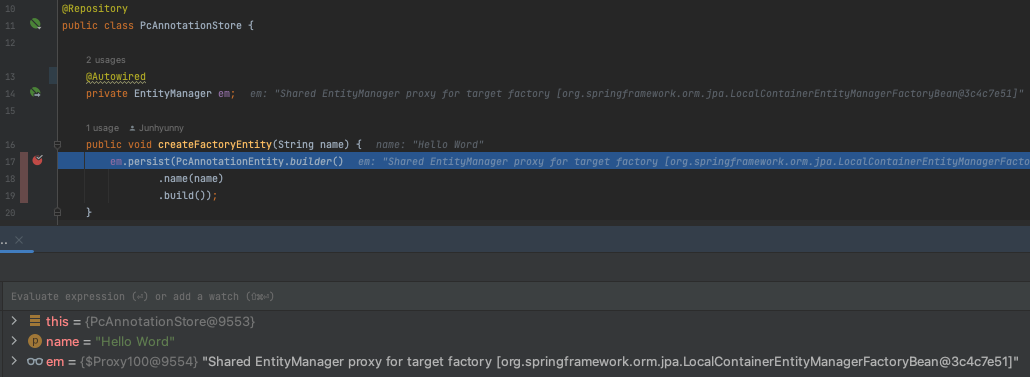
5.1. @PersistenceContext is same with @Autowired
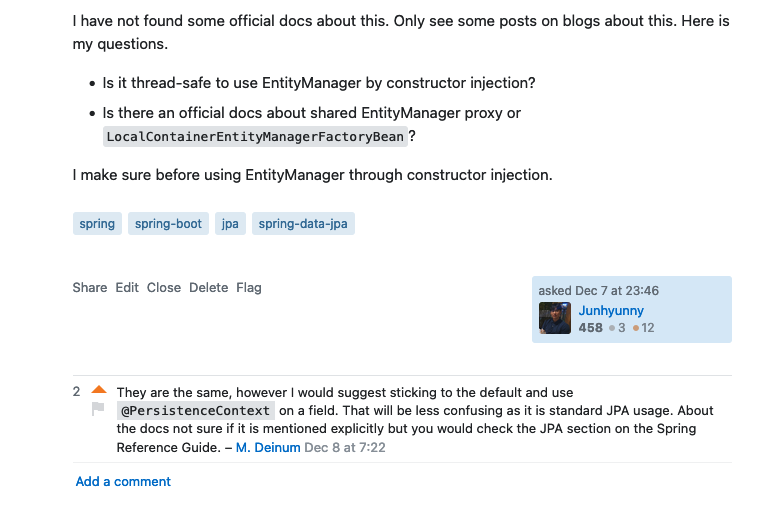
예전엔 반드시 @PersistenceContext 애너테이션을 사용해야 했지만, 특정 버전 이상부터는 @Autowired 애너테이션도 동일한 기능을 제공하는 것으로 보인다. 공식 문서에선 확인하지 못 했지만, 관련된 내용을 StackOverflow에 문의한 결과 다음과 같은 답변을 받을 수 있었다.
- 두 방법은 동일하지만,
@PersistenceContext애너테이션을 사용하는 것이 명시적이고, 표준 JPA 사용 방법이다.
TEST CODE REPOSITORY
REFERENCE
KEEP READING
함께 읽으면 좋은 글
DISCUSSION